Album Release

Tuesday, May 29, 2012

The Five Senses of a Second-String Harpist


Sometimes I wish my passion was math or house construction. Take math: it's straight forward and intellectually stimulating. I would work comfortably inside an office and could shut off the computer on Friday to forget about "work" until Monday. Or construction: I would work outside in the morning, have a delicious lunch prepared by my wife at noon, take a 20 minute nap, then work outside in the fresh air until 5PM when I would then forget about "work" until the next morning. It's physically stimulating, and there is complete closure with the finished product. I would spend rainy days in my pajamas. 

But no. Harp is never over. There's no real finished product, and there seems to be thousands of variables that affect a performance. It is, however, intellectually and physically stimulating.

I think about this sometimes on my way to gigs. Just getting the gig and getting to the gig is 90% of the battle. I usually arrive pooped, thirsty, and feeling under-practiced. In my mind I calculate my hourly wage and take into account practice time, travel time, rehearsal time, performance time, the price of the gut string that broke, and the foisted speeding ticket. Why the heck? 

At this point, I see all past gigs flash before my eyes. I'm thankful to have had the opportunity to make music with different people in different places. The most exhilarating and memorable performances are those in which I was the replacement harpist for the really good harpist that was sick or on vacation. I squeaked into their spot because I was the kid in the right place at the right time. It's not math or concrete, but I'm thankful to be me. 

So all of this was on my mind Sunday on my way Monaco. I was hurrying along to play for a Grand Prix post party (playing as the 4th harpist in a group called Harpissimo). I took this picture at the top of Monaco 2 minutes before the start of the race. I had never been to a car race (what do you call them?), so by the time I got to the center of the city, I was in shock by the actual SOUND of the thing. If I hadn't known what it was, it would have scared the living begeebees out of me. I didn't see the cars, only heard them. Wow! Loud. Ghostly. 

I got to thinking: this is the loudest gig I've ever played. One thing led to another, and here are the other top 4 Sensory Memories in the Gig Life of Megan:

Smell:
L'église de la Madeleine, Paris. 
Replacing the harpist in a small orchestra for the production of the oratorio: "Marie de Magdala" by Michel Garnier.
This cathedral is amazing to be in and to make music in, but the incense. The incense. 

Taste:
4th of July in Zilker Park, Austin, Texas
Replacing the harpist with the Austin Symphony in their outdoor spectacle. 10,000 people! Fireworks and patriotism.
You could taste the hot. 

Touch:
Playing with the 60's group "Cowsills" for a show in Los Angeles. 
My only role was to play really loud glissandos for one song... to the point of ginormous blood blisters on various fingers and the subsequent popping of the ginormous blood blisters during the show. I can still feel those glissandos. 

Sight: 
Beverly Hills, but I forget the function. I was playing for the cocktail party and there was a band going on after dinner. After I played, I came across this band in the musician hang-out area. They were so nice!
I found out later they were the Beach Boys. Doah!

Et voila.

I'd like to thank Eloise for this blog post- who took an unprecedented 4 hour nap today! 

View of Monaco from the car minutes before the Grand Prix.


Friday, March 30, 2012

Harp Yoga for New Moms


Ok, everyone! Get out your copy of Ed. Larivière "Exercices et Etudes pour la Harpe" op. 9.

Harp yoga for new moms. That's right. 

I find myself with very very very little time to play the harp these days while managing baby and household. No complaints, although I miss having daily time to indulge in projects and repertoire. Those days are on hold for now and these days I really enjoy playing: etudes! Slowly. As if each movement and note was a meditation. An hour of slow scales and exercises can be as rejuvenating as a nap. 

It's not the sun salutation series, but you've got it all in this book: breathing, awareness, focus, relaxation, strengthening, and stretching. 

The discipline of studying certain exercises, let's call it harp yoga, started for me when I was studying with Delaine Fedson. She graciously suggested that my technique needed work, and she was right. And it's never finished or complete, this thing of technique. Having a solid technique on any instrument means having the agility and strength to achieve the sound and speed you want. Right now (with little Eloïse), I'm not keen to invest emotion into a new piece. I don't have the mental energy to memorize notes, yet I long to touch the harp. And this is where Ed. Larivière is helping me.

Why this book of etudes and exercises? I've spent recent years using it, and it's become like a cozy pair of pajamas. It's not volumes and volumes of exercises- only 30 pages. Unlike the extensive Grossi, Pozzoli, Bochsa or Salzedo methods and studies-- this one is concise and dense. It takes me about 3.5 hours to get through all 79 exercises (1.5 hours on the first 4 alone!).

After spending years training the body to play ergonomically, just opening up an exercise book makes me engage all the muscles in my body in a supple fashion, find my sitz bones, sit up tall like a ballerina, and breathe. I practice unwinding the muscles in my jaw. I pay attention to the upper back. I make sure there's a lot of finger flesh on the strings and that the fingers close directly into the palm, immediately releasing tension upon plucking. 

Like yoga, this isn't just another exercise program. It's a practical and methodical application of awareness and self study. The goal is consistent, hearty, and buzz-free sound. Unless I'm thinking about each motion and note, I'm wasting my time. I love it! Because even if there's only 15 minutes to spare at the harp, you can go there, to this place of sound and motion, then come back and get on with diaper changing. 

But hold the phone: who made this stuff up? Alphonse Hasselmans of course! The French granddaddy of the pedal harp (1845-1912) and one of the most significant harp teachers of all time. Apparently, it was a student at the Paris Conservatory, Raphaël Martenot, who dictated these gems. Martenot added a little note explaining a few of the exercises in the beginning of the book. I'm not sure of when they were put on paper. The publisher Alphonse Leduc first printed this collection in 1946, more than 30 years after Hasselman's death. 

Just to point out a few super fun (and significant) exercises, take number 13 for example: 3 octave scales in both hands. This one is important because it allows me to push for equal sound on every note, even though every string is a different gauge and even though it spans three different types of strings (metal, gut, nylon).

Whenever there is a slur in this book, it's there for a good reason. It's a guide for phrasing and breathing (page 9 and 10, for example).

Speaking of page 10, I like this set of scales because it sounds like different sets of voices in a choir. The trick is to listen to two voices at the same time. It's like needing two sets of ears. Fun. No really. It's fun!

If I've got just a few minutes to spare, it's nice to dive into the mini-exercises  (Number 4, marked "Theme and Variantes"). These are basically arpeggiated chords in different patterns: sets of 4 notes at a time in one hand in a certain order, with the same set of notes in the other hand but not particularly in the same order or direction! 

There are a few that just feel good in the hands:
- the second to the last measure on page 5
- page 6 line 3 measure 2 & 5
- page 7 line 1 measure 4

If I want to stretch my mind a bit and even go cross eyed for a second (and if I'm going hard-core, I do it decaffeinated):
- page 6 line 4 measure 4
- page 6 line 5 measure 5
- page 6 line 6 measure 3
- page 7 line 2 measure 2

And before I become overly long-winded, let's look at the 3 "etudes" in the book. These are occasions to put into practice the previous exercises. It may sound bland, but these etudes are sooooo lovely and sweet. Its the best use of peas and carrots that I've ever heard. My favorite: the third. Allegro con fuoco in f minor. A little sad and particularly challenging. Mmmm. And so rewarding. 

Namaste,
Megan

Saturday, March 3, 2012

What should I do?


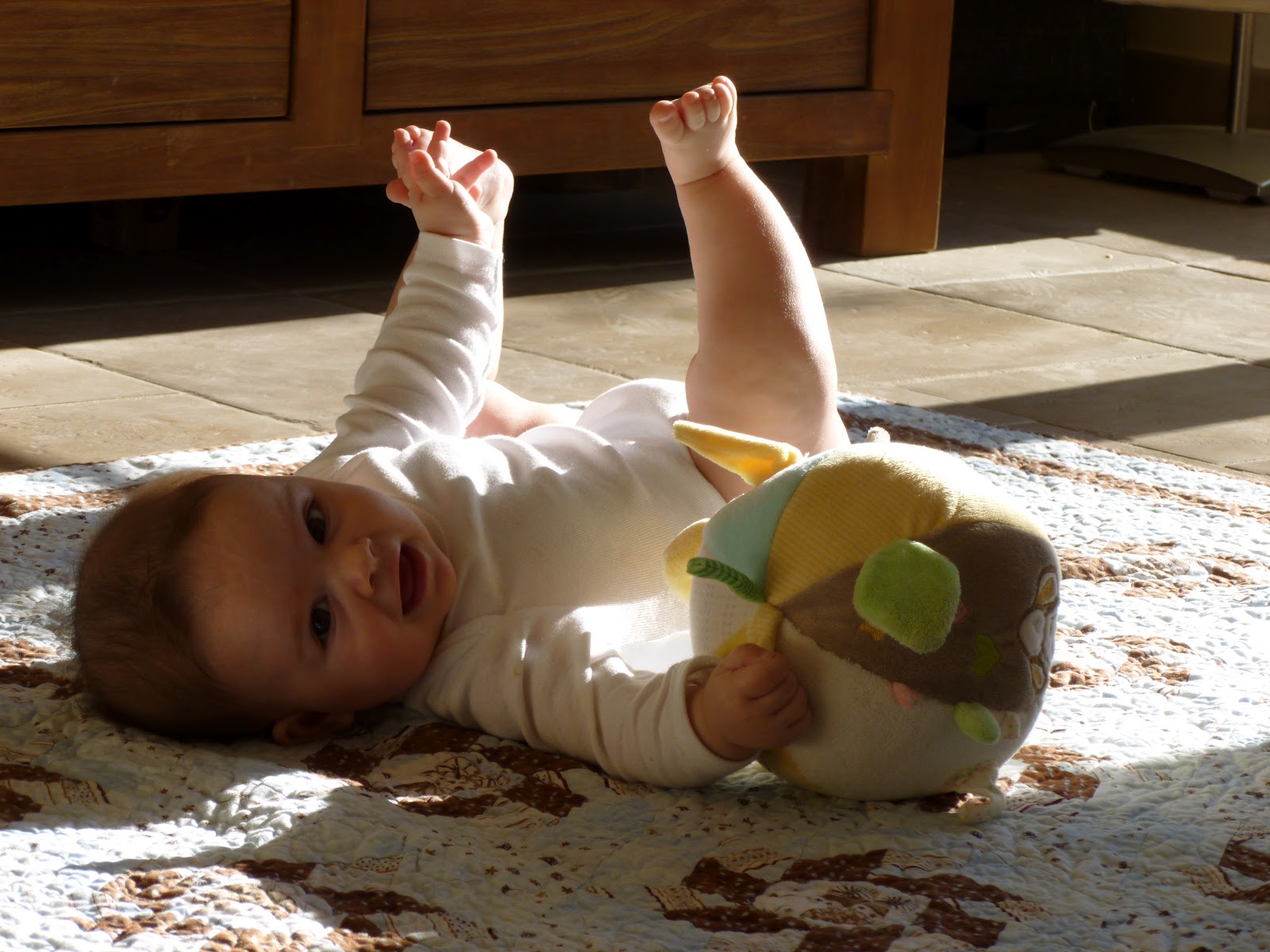
Eloïse, my 5 month old sweetie pie. 

After a year-long hiatus from this blog, I'm really happy to be typing away again.

What a difference a year makes! Long story short: I am a mom! Eloïse... my 5 month old sweetie pie. She is pure joy, and I'm so very thankful for her. One thing is for sure: something very deep inside me has changed. And of the thousand pieces of advice I've been given over the past year, there is a common thread among them all: take advantage of the time that passes so quickly. Seems valid. So I've spent the past 5 months (and even some months before that) concentrating on baby/mom bonding. I've got first-time-mom syndrome, as my friend put it, and seem to always be holding her or focusing my attention on her. I especially enjoy staring at her and smelling her.  I don't believe it's possible to spoil a baby, but I'm sure as hell trying.

So... coming back to Earth slowly after being happily absorbed in baby bubble. We are still together nearly 24 hours a day, but I'm feeling more settled and definitely more rested these days. I know already that Eloïse is going to help me slow down and single task, which has not previously been very Megan-like. In a way, I feel like I'm re-living my life.

The title of this blog is: What should I do?... Remarking on friends, family and people in general and thinking on my new life as a mom has gotten me asking this question. What are we supposed to do with our lives? What's my purpose in the world? What can I do to be happy? How am I supposed to use my talents? How is a right brained person supposed to earn a living?

When I was 17 and in embarking on college education and decisions of what to do after graduating high school, I remember my friends and I feeling huge pressure to decide what track to jump in to:  business? arts? science? What in the world am I supposed to do "for the rest of my life"?  15 years later, it's obvious that whatever we decide to do will change. Life happens. Time and chance happens. Relationships change. Bodies change.

And this is the beauty of it. Things change.

Speaking of change, and speaking from a musician's standpoint, it's not easy to pick up, leave, and start working again from scratch. It takes time and connections to get up and running in a new neighborhood, and I felt the reality of this when I moved back to France. There were two great harp teaching positions that I applied for right after I moved; I didn't get either one. I couldn't convince them that I was the PERFECT person for their school. Frustrating. I'm not too good at not working.

An idea for a new project was conceived about the same time as Eloïse: I'll start a music school in Cabris. We needed one. We needed people walking around the village with their violin case. We needed little concerts. We needed people playing music and having music education readily available to them. In my opinion. :-D

And voila: the Académie de Musique Internationale. It kind of came together as if I wasn't the one heading it up; it just happened. My family in law owns a portion of a farm house (mas) just behind where I live. It was empty and in need of a fix-up. The people that lived there before had cleaned out all of their possessions. Everything, get this, but a piano. And a guitar pick. It was a sign.

I'm not sure of the details, but the building is at least 200 years old and started out as a tool factory. I love this because a music school is just that: a tool factory. A place to make tools (skills, perspectives, ideas, experience) that you can use outside of the tool factory.

I'll be honest. The place still needs fixing up. It's looking better and better, though, and each week about 60 music students come through there to create music. Piano, guitar, flute, voice, violin, drums, and harp of course. Who would have thought?

Someone once gave the advice: "Whatever your hand finds to do, do it with all of your might." "Eat, drink, and enjoy your short and meaningless life."

Another wise person said:  "Three things will last forever--faith, hope, and love--and the greatest of these is love."

And another: "What does God require of you? To do justly, and to love mercy, and to walk humbly with your God?"

Love, walk in humility, enjoy what we have and who we have, and work hard. That's what I should do. What we should do. It comes out differently in all of us, and comes out differently in different days and years, but I really believe it's that simple.

Love, walk in humility, enjoy what we have and who we have, and work hard.

Wednesday, January 12, 2011

Corsica

As may be expected, this photo doesn’t at all capture what’s happening in the distance. You can hardly make out the lump of blue mountains sitting on the sea. Same for the Grand Canyon or the  Mona Lisa... a picture’s not gonna cut it. 

It only happens in the winter, on cold days, when the wind is blowing and the air is clean, during sunset or sunrise...
...the view of the island Corsica from Cabris.
It’s 200 kilometers from here, and a difference in elevation of 600 meters, and a few times a year, for a few minutes, the island emerges between the vast blue sky and Mediterranean sea, then slowly sinks away again.
There are words to describe what’s happening, but no words to describe the experience.
It’s hands down my favorite part of living in this village. Whatever you’re doing at the moment becomes totally unimportant. Pull over. Stop the conversation. Quiet yourself and watch this stunning spectacle.
There are a few memories that I can compare it to- the first view of the Grand Canyon, for example. Your breath stops for a moment in amazement.
The first time you listen to Barber’s Adagio for Strings- another example. Not the first time that you hear it, but the first time that you listen to it. 
It’s the lump in the throat. The realization that we are so small compared to this stupefyingly giant world. The reminder that the ironing waiting to be done and the house and errands to be run are significantly unimportant. The awareness of a Creator whose works are majestic and beautiful. The feeling of comfort, and of a Shepherd’s voice that is saying:
“I’m here and I care about you. Even if you can’t see me all the time, I’m here. I love you.”

Wednesday, December 22, 2010

Winter's Eve

It’s winter’s eve, the last day of autumn. 
Winter’s eve and the Christmas tree was bought and decorated today.
Winter’s eve and a new baby was born in the village last night.
Winter’s eve and the close of my first full season back in France, a new chapter of life in many ways. 
Winter’s eve I’m feeling the weight of time around me, around people I love. 
Time... an instance, a pattern, and the indefinite continued progress through existence. 
Seasons... one way we figure and observe time passing before us. 
Autumn... the season when crops are gathered and leaves fall. The season after the long days of warm summer and the season before winter’s rest. 
“... Unless a seed of grain goes into the earth and dies, it is still a seed and no more; but through its death it gives much fruit...”
Seeds must die to continue living... 
The Earth must settle itself slowly into winter’s rest... 
What begins as a lively and active time of harvest becomes a spectacle of color, dancing itself slowly to sleep. Autumn Dances... Danses d’Automne. I think this is what the project will be called. 
Thank you, whoever you are, for reading. Thanks for letting me ramble about these Autumn pieces. There’s still so much to discover and write about. One piece in particular, Danses d’Automne by Bernard Andres, is going to wait a few months to appear in the blog, as I am planning to meet him and play this piece for him for his feedback and insight in the coming months. So excited!
The ideas keep coming, of which I’m glad. 

But for now, Autumn is slipping to sleep. 
Winter’s eve. 

Monday, December 20, 2010

Tchaikovsky: Autumn Song

Coldness in Berlin last week during a visit to my friend Ari and her sister (and baby Max). Christmas Markets, glüwein, tons of sugary temptations, coffee, and snow. I think I came out one too many for wieners consumed. 

Short visit to Berlin last week... it is NO LONGER Autumn there, wow. No leaves on the trees. Fresh snow every morning. Buuurlin. Lots of Christmas markets, Glüwein, sleds, mittens, and sugary snacks. 
There are, however, 6 remaining leaves lingering on the tree outside my bedroom in Cabris... and two more autumn pieces I’ve been wanting to blog about. I’m going to try to get them in before this chapter closes and winter officially begins... going by the books, that would be December 21st. 
This blog entry looks at Tchaikovsky’s “October: Autumn Song.” 
It’s amazing to me how some composers are able to start and finish a work in one single sitting. It happens in different ways in all kinds of music. Beck created the entire album “Sea Change” in one week. Mozart apparently composed the Overture to Don Giovanni in 3 hours. This piece is a taste of the same.
Peter Ilyich Tchaikowsky (Russia, 1840-1893) wrote a piano solo for each month of the year, each one  of them created in a single day (as the story goes). He was commissioned for this cycle by a monthly musical journal in Saint Petersburg, Le Nouvelliste (Why is this in French?) for 1876.
There’s a great quote about this commission from his friend and colleague listed in the Urtext preface:
“Tchaikovsky accepted the commission and carried it out with his habitual punctiliousness. He himself found the task very simple and inconsequential, and in order to maintain the prearranged delivery schedule he instructed his servant to remind him about the commission on a particular day each month. The servant followed this order to the letter and reminded him each month on a particular day: ‘Peter Ilyich, it’s time for your shipment to St. Petersburg’. Peter Ilyich then sat down, wrote the piece in a single sitting, and sent it off. Despite the obvious nonchalance of its creation, the cycle of piano pieces cam off magnificently.”
                 
I imagine him finishing up his coffee, sharpening his pencil, sitting down to the piano, and quietly searching within him for the inspiration to produce these short pieces. 
The original publisher/editor was the one that added the subtitles and threw in little epigrams by Russian poets... “October” has the subtitle “Autumn Song” with an epigraph by Aleksey Nikolayevich Tolstoy:
Осень, осыпается весь наш бедный сад,
Листья пожелтелые по ветру летят...
Autumn, falling down on our poor orchard,
the yellow leaves are flying in the wind...
I can see that image when playing this piece- an orchid being tossed around by the autumn wind in slow motion. “Andante doloroso e molto cantabile,” with a dose of lament and sorrow. 
I first came across this piece when searching for Autumn tunes long before this project became official. The intention was to transcribe it for harp and publish it in dedication to one of my students back in West Texas- Katherine Kappelmann. She’s been gracious to bear with many drafts and editions over the past months. 
It’s such a transparent and expressive piece--- and lays so well on the harp! There were only 2 notes that had to be nixed somewhere in the B section; I was a dollar short in the C natural category.
Full moon tonight, and clear skies here. Making out a moonlit orchid in my mind. 

Wednesday, December 8, 2010

Automne by Marcel Grandjany

It’s another drizzly morning here and I’ve got my coffee in hand, thinking about these last weeks of autumn. 
There have been a couple of blog posts so far that mention composers and artists that have created a work for each of the seasons- a series. This one describes a piece by a composer who wrote only for autumn...
Marcel Grandjany (1891-1975)
Automne... 1 movement/ 4 pages/ 3 minutes
Written (in New York I think) around 1927 for his student Barbara Blumenthal (never heard of her)
I love this piece because it’s a typical example of Grandjany’s writing: rich 7th and 9th-chords, haunting melody, COLOR through harmonics, glissandos... whether “simple” or “difficult,” Grandjany’s music is profound and pleasing. Never imposed. Gentleman-like. 
Grandjany was a French-born harpist and organist who spent much of his life in the United States. Words that I associate with him are:
Marcel Grandjany
Henriette Renie (his teacher)
Alphonse Hasselmans (his teacher)
Julliard (professor)
Montreal Conservatory (professor)
Manhattan School of Music (professor)
Sensuous (in performing and composing)
Spatula-like fingertips
Technique
Pedagogue
American Harp Society (founder)
Carlos Salzedo (his “rival” colleague)
Virtuoso 
I’ve been reading a lot of Autumn poetry and came across this one. For me, it reflects the idea and atmosphere of this piece. Enjoy :-) 
My November Guest by Robert Frost
My Sorrow, when she's here with me,
Thinks these dark days of autumn rain
Are beautiful as days can be;
She loves the bare, the withered tree;
She walks the sodden pasture lane.
Her pleasure will not let me stay.
She talks and I am fain to list:
She's glad the birds are gone away,
She's glad her simple worsted grey
Is silver now with clinging mist.
The desolate, deserted trees,
The faded earth, the heavy sky,
The beauties she so truly sees,
She thinks I have no eye for these,
And vexes me for reason why.
Not yesterday I learned to know
The love of bare November days
Before the coming of the snow,
But it were vain to tell her so,
And they are better for her praise